Apr 23, 2010

Databases: A Beginner’s Guide

Databases: A Beginner’s Guide


Andrew J. Oppel "Databases: A Beginner’s Guide"

McGraw-Hill | Mar 2009 | English | ISBN-13: 978-0-07-160846-6 | 497 Pages | PDF | 9.05 MB

Learn standard database design and management techniques applicable to any type of database. Featuring clear examples using both Microsoft Access and Oracle, Databases: A Beginner's Guide begins by showing you how to use Structured Query Language (SQL) to create and access database objects. Then, you'll discover how to implement logical design using normalization, transform the logical design into a physical database, and handle data and process modeling. You'll also get details on database security, online analytical processing (OLAP), connecting databases to applications, and integrating XML and object content into databases.

Designed for Easy Learning

    * Key Skills & Concepts--Chapter-opening lists of specific skills covered in the chapter
    * Ask the Expert--Q&A sections filled with bonus information and helpful tips
    * Try This--Hands-on exercises that show you how to apply your skills
    * Notes--Extra information related to the topic being covered
    * Self Tests--Chapter-ending quizzes to test your knowledge

About the Author

Andy Oppel has taught database technology for the University of California for more than 20 years. He is the author of Databases Demystified and SQL Demystified, and the co-author of SQL: A Beginner's Guide, Third Edition. 

Download:
Read more

Birds Of The World


Birds of the World (DK Handbooks) By Alan Greensmith

Publisher: DK ADULT 1993 | 416 Pages | ISBN: 1564582965 | PDF | 59.5 MB
Authoritative text, crystal-clear photography, and a systematic approach make this the most comprehensive pocket guide to birds of the world. Featuring over 800 bird species, this volume is designed to simplify the sometimes complex identification process. Whether in your neighborhood or in the wild, the DK Handbook of Birds of the World enables you to spot and recognize birds easily. Photo-Encyclopedic Approach: Each entry combines a precise description with an annotated photograph to highlight the bird's chief characteristics and distinguishing features. There are useful maps showing worldwide distribution, pictures of alternative plumage, and scale drawings of each bird. Color-coded, quick-reference bands giving at-a-glance facts complete every entry. Identification Made easy: For beginners and established enthusiasts alike, the DK Handbook of Birds of the World begins by describing anatomy and behavior to help identify different types of bird. A visual identification key then shows the major bird groups and guides you to the correct entries. Finally, a concise glossary provides a useful guide to the scientific and technical terms used in the book.


Read more

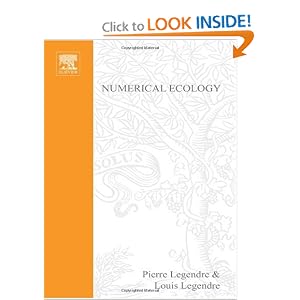
Numerical Ecology

Numerical ecology


Numerical Ecology (Developments in Environmental Modelling): P. Legendre, L. Legendre 
Elsevier Science | ISBN: 0444892494 | 1998-11-01 | PDF  | 870 pages | 4.48 Mb

The book describes and discusses the numerical methods which are successfully being used for analysing ecological data, using a clear and comprehensive approach. These methods are derived from the fields of mathematical physics, parametric and nonparametric statistics, information theory, numerical taxonomy, archaeology, psychometry, sociometry, econometry and others. Compared to the first edition of Numerical Ecology, this second edition includes three new chapters, dealing with the analysis of semiquantitative data, canonical analysis and spatial analysis. New sections have been added to almost all other chapters. There are sections listing available computer programs and packages at the end of several chapters. As in the previous English and French editions, there are numerous examples from the ecological literature, and the choice of methods is facilitated by several synoptic tables.


Review:


This is the best book on numerical ecology available. Legendre & Legendre are already a classical on communities data analysis, and this second edition is a fundamental update. The book should be always around when you are analysing complex data sets and want a correct method and a valid interpretation.

Read more